
Insurance Premium Audit Automation: How AI Helps Review Payroll Documents, Verify Data, and Complete Audits Faster
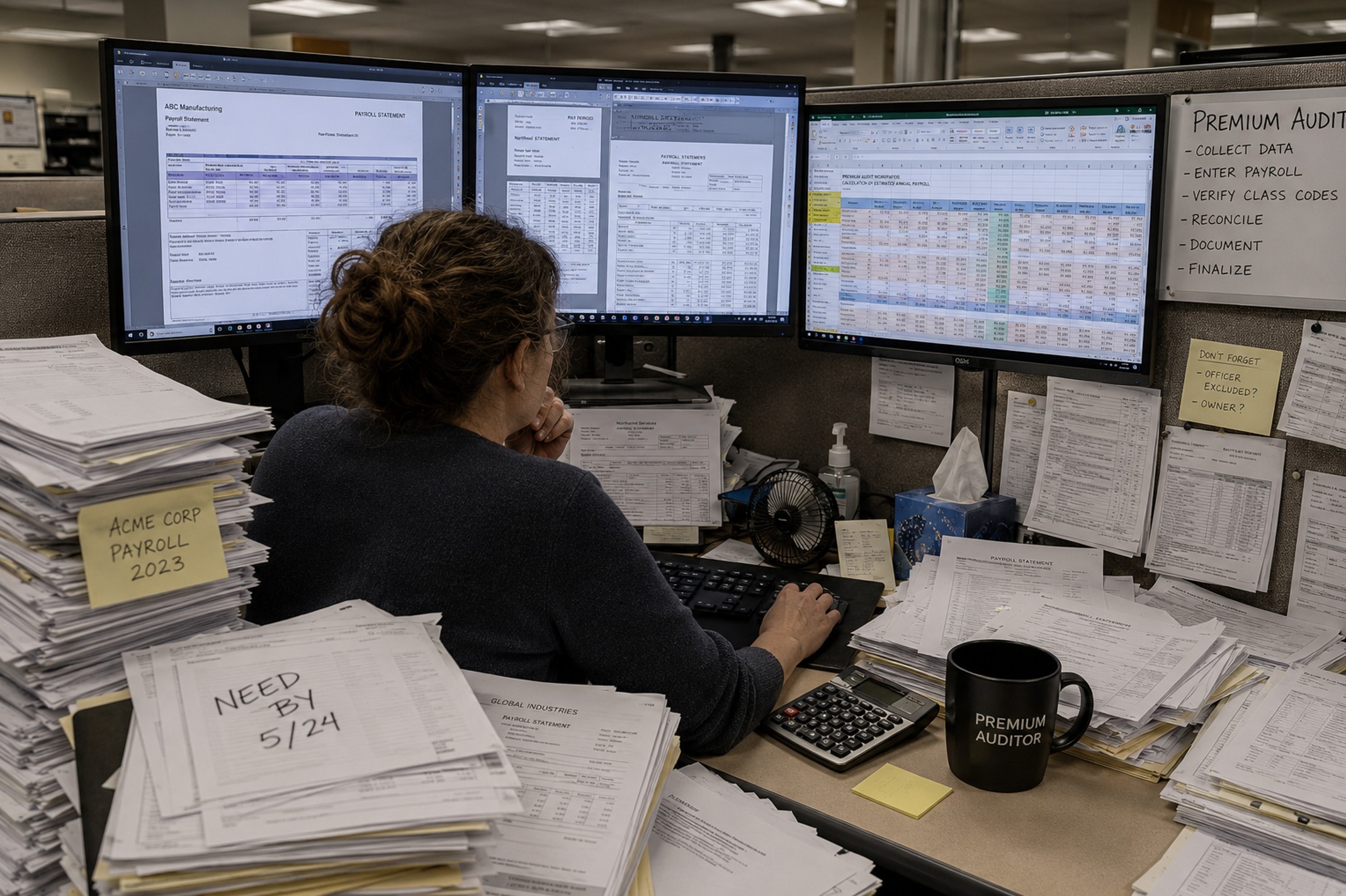
Insurance premium audits play a critical role in helping insurers confirm that the premium charged for a policy reflects the policyholder’s actual exposure during the policy period. In workers’ compensation, that often means comparing estimated payroll, employee classifications, subcontractor exposure, and supporting documentation against what actually happened during the year.
The concept is straightforward. The execution is not.
A workers’ compensation policy is often priced at the beginning of the policy period using estimates. An employer may estimate its payroll, employee count, job classifications, locations, and use of subcontractors. At the end of the policy period, the insurer conducts an insurance premium audit to review the actual records and determine whether the original premium was accurate.
If payroll was higher than expected, the employer may owe additional premium. If payroll was lower, the employer may receive a return premium. If employees were classified incorrectly, subcontractors were not properly insured, or records do not align, the final premium can change.
That final premium calculation is usually not the hardest part. The harder part is finding, reviewing, organizing, and verifying the documentation needed to support it.
Premium audit teams routinely review payroll reports, tax documents, subcontractor records, certificates of insurance, spreadsheets, emails, general ledger reports, and scanned PDFs. Every employer provides information differently. Every payroll system generates reports in its own format. Every audit requires the auditor to transform inconsistent documents into usable information before a final decision can be made.
This is part of a broader shift toward AI for insurance workflows, where teams are using AI to review, structure, and verify complex operational documents.
That is why insurance premium audit automation has become such a strong use case for AI.
For years, insurers have attempted to automate portions of the premium audit process using OCR, templates, and document extraction tools. Those technologies can be helpful, especially when documents are standardized. But real-world premium audit documentation is rarely clean or consistent enough for rigid automation to work reliably at scale.
Today, advances in AI are creating a new opportunity. Rather than simply reading text from documents, modern document AI can help understand context, interpret different document layouts, normalize inconsistent data, compare information across files, apply audit guidelines, and generate structured outputs auditors can use.
As Brad, CEO of Nomad Data, puts it:
“Premium audit is a great example of where AI needs to do more than extract fields. The real value is in helping teams make sense of messy, variable documents and move more of the review process forward with confidence.”
That distinction matters. Insurance premium audit automation is not just about faster data entry. It is about helping audit teams complete more of the audit workflow with greater consistency, traceability, and speed.
What Is an Insurance Premium Audit?
An insurance premium audit is a review conducted after a policy period ends to determine whether the premium originally charged accurately reflects the insured’s actual operations during that period.
Many commercial insurance policies are issued based on estimated exposures. For workers’ compensation insurance, premiums are commonly based on estimated payroll and employee classifications. For general liability policies, premiums may be based on payroll, sales, revenue, subcontractor costs, or other exposure measures.
At the start of the policy period, the insurer uses the best available estimate to price the policy. But a lot can change over the course of a year.
A company may hire more employees. Payroll may increase. Employees may move into different roles. A business may add new locations. It may use subcontractors more heavily than expected. It may change operations in ways that affect risk.
The insurance premium audit helps reconcile the original estimate with the actual exposure.
In simple terms, the insurer is asking: Did the business pay the right premium based on what actually happened during the policy period?
To answer that question, auditors need to gather and review supporting documentation. They may need to verify payroll by class code, confirm officer payroll, check subcontractor certificates of insurance, compare tax filings against payroll reports, review job duties, and determine whether records align with policy requirements.
For workers’ compensation insurers, the stakes are significant. Premium audits help ensure that policyholders are charged accurately and that risk is classified properly. They also help protect the integrity of underwriting, pricing, and loss ratio analysis.
But while the purpose of an insurance premium audit is clear, the workflow behind it can be extremely manual.
Why Insurance Premium Audits Are So Document-Heavy
Insurance premium audit work depends on documentation from multiple systems, departments, and formats.
Common documents used in an insurance premium audit include:
- Payroll reports
- Quarterly tax filings
- Annual tax forms
- Employee classification records
- General ledger reports
- Subcontractor records
- Certificates of insurance
- Policy documents
- Applications and endorsements
- Spreadsheets
- Email correspondence
- Scanned PDFs
- Paper records converted into images
Each document may contain information that affects the final premium. The auditor’s job is to locate the relevant information, determine whether it is complete, compare it against other records, and decide whether anything requires additional follow-up.
That creates a major operational burden.
The problem is not simply that there are many documents. It is that those documents were not created for premium audit purposes. Payroll reports are created for payroll administration. Tax forms are created for compliance. Certificates of insurance are created to prove coverage. Spreadsheets may be created internally by accounting teams. Emails may contain clarifications or exceptions that are not reflected in the formal records.
Premium auditors often need to piece together a complete picture from documents that were never designed to work together.
For example, an employer may submit payroll reports that break down wages by department, while the workers’ compensation policy requires payroll by classification. A tax filing may show one total, while the payroll report shows another. A subcontractor certificate may be missing a coverage date. A spreadsheet may contain notes that explain a discrepancy, but those notes may not be obvious without careful review.
This is why insurance premium audit work often becomes a document interpretation challenge.
Auditors are not only extracting data. They are asking questions like:
- Does this payroll report cover the full policy period?
- Do the totals match the tax filings?
- Are employee roles mapped to the correct class codes?
- Are subcontractors insured?
- Are any certificates missing, expired, or incomplete?
- Are there excluded payroll categories that need to be handled differently?
- Does the documentation support the final premium calculation?
Those questions require judgment, but they also require a tremendous amount of document review. That is where AI can help.
The Challenge: Every Employer Sends Different Payroll Documents
One of the biggest obstacles to insurance premium audit automation is the variability of employer documentation.
No two businesses submit information in exactly the same way. Even when two employers use the same payroll provider, their reports may look different depending on their settings, departments, reporting periods, export format, and internal payroll structure.
Auditors may encounter payroll reports with different column names, different layouts, different levels of detail, and different terminology. One employer may label employees by department. Another may label them by location. Another may export payroll by earning type. Another may send a PDF summary instead of a spreadsheet.
Some reports are clean and structured. Others are scanned, rotated, incomplete, or spread across hundreds of pages. Some include employee-level detail. Others include only totals. Some show regular wages, overtime, bonuses, and reimbursements separately. Others roll categories together.
This variability creates a major challenge for traditional automation.
Conventional OCR can read text from a document. Template-based extraction can pull data from predictable fields. Rules-based systems can work well when the same form appears again and again.
But insurance premium audit documents do not behave like standardized forms.
Premium audit teams need to process a wide range of document types from a wide range of employers. The system cannot assume that payroll totals will appear in the same place. It cannot assume that class codes will be labeled consistently. It cannot assume that supporting documents will arrive in the right order or that all required information will be present.
As Brad explains:
“The premium audit workflow is difficult because the inputs vary so much, but the review logic is repeatable. That combination is exactly where AI can be useful. You need flexibility on the document side and structure on the workflow side.”
That is the key insight.
Insurance premium audit automation is not just a matter of digitizing paper. It requires the ability to interpret different documents, extract relevant information, normalize outputs, compare records, and support the specific guidelines auditors need to follow.
In other words, the challenge is not reading the document. The challenge is understanding what matters inside the document.
Why Traditional Automation Falls Short
Many insurers have already invested in some form of document automation. These tools often include OCR, forms processing, data capture, or workflow routing.
Those capabilities can be useful, but they often fall short in complex premium audit workflows.
The reason is simple: traditional automation depends on predictability.
That is also why many insurance document automation projects struggle in the real world, especially when the documents are variable, incomplete, or difficult to standardize.
If a document always follows the same structure, automation can be configured around that structure. For example, if every form has the same field in the same location, the system can be trained to extract that field. If every document uses the same label, the system can find it.
Premium audit documentation is different.
The inputs are diverse. The structure changes constantly. The same concept may be expressed in multiple ways. A relevant data point may appear in a table, a note, a scanned image, an email attachment, or a spreadsheet tab.
Even when traditional systems extract some data correctly, auditors may still need to spend significant time checking the output. If the system is brittle, misses context, or fails when a document format changes, the efficiency gains quickly disappear.
That is why many document automation efforts stall after the first layer of extraction.
They may help digitize documents, but they do not complete enough of the audit workflow to transform operations.
For insurance premium audit teams, the goal is not simply to get text out of a PDF. The goal is to produce reliable, audit-ready information that can support a final review.
That means automation needs to help with multiple steps:
- Identifying document types
- Extracting relevant information
- Normalizing inconsistent formats
- Comparing information across documents
- Flagging missing or conflicting data
- Applying carrier-specific guidelines
- Producing structured summaries
- Providing source references for verification
This is where modern AI and tools like Doc Chat can change the workflow.
How AI Can Help With Insurance Premium Audit Automation
Modern AI systems are better suited to the variability that makes insurance premium audit work difficult to automate.
Instead of relying only on rigid templates, AI can analyze documents in context. It can recognize patterns across different formats, understand relationships between fields, and generate structured outputs even when the source documents are inconsistent.
For premium audit workflows, AI can help across several key areas.
Data Extraction
AI can identify payroll data, employee details, subcontractor information, coverage dates, class codes, and other relevant fields across a wide range of document formats.
Rather than requiring every document to follow a fixed template, AI can interpret the document structure and extract the information that matters.
For example, Doc Chat could help an auditor ask: What payroll totals are shown for the policy period? Which employees are associated with each classification? Are there subcontractor payments listed in the general ledger? Which certificates of insurance are included?
The system can then surface answers with references back to the source material.
Data Normalization
Extraction alone is not enough. Premium audit teams need information in a standardized format.
AI can help transform inconsistent records into structured outputs that auditors can actually use. That may include organizing payroll by employee, class code, state, location, department, or earning type. It may also include converting inconsistent labels into a common structure.
This matters because the source documents may not match the format needed for the audit.
An employer may send payroll by department, but the auditor needs payroll by classification. Another may send payroll by pay period, while the audit requires a policy-period total. Another may send multiple spreadsheets with different tabs and naming conventions.
Doc Chat can support this kind of normalization by helping turn variable input documents into consistent, reviewable outputs.
Document Classification
Premium audit files often contain many different kinds of documents. Some are payroll records. Some are tax forms. Some are certificates. Some are supporting correspondence. Some may be irrelevant or duplicative.
AI can help classify documents by type and determine how each should be handled.
This allows the workflow to move more efficiently. Payroll reports can be processed as payroll reports. Certificates can be reviewed for coverage details. Tax forms can be compared against payroll totals. Emails can be reviewed for clarifications or missing context.
This is especially useful when audit files arrive as large, mixed document sets.
Validation & Verification
Insurance premium audits depend on accuracy. It is not enough to extract a number. The auditor needs to know whether that number is supported, complete, and consistent with the rest of the file.
AI can help flag potential issues, such as:
- Payroll totals that do not match across documents
- Missing reporting periods
- Expired or missing certificates of insurance
- Subcontractor payments without supporting coverage
- Classification inconsistencies
- Missing employee details
- Conflicting entity names
- Gaps between policy dates and document dates
- Unexpected changes from prior audit records
These comparison-heavy tasks are similar to other AI document comparison workflows, where the value comes from finding inconsistencies, missing information, and unsupported claims across multiple files.
This does not remove the need for auditor oversight. Instead, it helps auditors focus on the areas that require attention.
Rather than reading every page manually to find possible exceptions, auditors can start with a structured view of what appears complete, what appears inconsistent, and what needs follow-up.
Audit Summary Generation
Once information has been reviewed and structured, AI can generate summaries that help auditors move faster.
A strong audit summary might include the documents reviewed, key payroll findings, missing items, discrepancies, subcontractor issues, and recommended follow-up questions.
Doc Chat can help generate these summaries with source-backed references, making it easier for auditors to trace findings back to the underlying records.
This is important because audit teams need confidence in the output. They need to know not only what the AI found, but where it found it.
Moving Beyond Data Extraction to Agentic Audit Workflows
Many insurance technology discussions focus on document extraction. That is understandable. Extraction is a visible pain point, and it is often the first step in automation.
But insurance premium audit workflows show why extraction alone is not enough.
The real opportunity is moving toward agentic audit workflows.
In simple terms, that means AI can help execute multiple steps in the audit process rather than only pulling fields from documents.
For example, an agentic workflow for an insurance premium audit might:
- Ingest a full audit file
- Identify and classify each document
- Extract relevant payroll, tax, policy, and subcontractor data
- Normalize the information into a standard format
- Compare totals across records
- Check for missing documentation
- Apply carrier-specific audit guidelines
- Flag exceptions for auditor review
- Generate a structured audit summary
- Provide citations back to the source documents
This is a much more powerful vision than basic extraction.
The same principle applies in underwriting submission triage AI, where AI is most valuable when it turns messy document packets into structured, decision-ready outputs.
As Brad says:
“The future of premium audit automation is not just ‘find the payroll number.’ It is ‘review the file, compare the data, follow the guidelines, tell me what is missing, and show me the source.’ That is where the workflow starts to change.”
That is also where Doc Chat fits especially well.
Doc Chat is designed for document-heavy insurance workflows where the inputs vary, but the review process can be defined. In a premium audit context, that means the system can be configured around the carrier’s audit guidelines, document requirements, output formats, and review expectations.
The result is not a black-box automation tool. It is a source-backed assistant that helps auditors complete more of the work while keeping humans in control.
Where Doc Chat Fits in the Insurance Premium Audit Process
Doc Chat is built for complex insurance document workflows that require accuracy, repeatability, and traceability.
Insurance premium audit is a natural fit because the workflow has three characteristics that align closely with Doc Chat’s strengths.
First, the document inputs are highly variable. Payroll reports, tax forms, spreadsheets, certificates, and supporting documents can arrive in many formats. Doc Chat can work across diverse document sets instead of depending on a single rigid template.
This is consistent with how Doc Chat supports broader document summarization AI for claims review, where source-backed answers and structured outputs help teams move faster without losing traceability.
Second, the review process is repeatable. While every employer’s documents may look different, audit teams often follow consistent guidelines. They need to check for required records, verify payroll, review classifications, evaluate subcontractor documentation, and flag exceptions. Doc Chat can support these repeatable workflows with structured outputs.
Third, audit teams need source-backed results. Premium audit work requires trust. Auditors need to confirm where information came from and verify findings before finalizing an audit. Doc Chat can provide cited answers that link back to the source material, helping teams maintain transparency and oversight.
For example, an auditor using Doc Chat could ask:
- What payroll documents are included in this audit file?
- Do the payroll records cover the full policy period?
- What payroll totals are shown by employee or classification?
- Are there subcontractor payments listed?
- Which certificates of insurance are included?
- Do the certificate dates cover the relevant work period?
- Are there discrepancies between payroll records and tax forms?
- What information is missing from the file?
- Create an audit-ready summary using our preferred format.
Instead of manually searching through every file, the auditor can start with a structured, cited view of the information. That can reduce review time, improve consistency, and help audit teams focus their attention where it matters most.
Doc Chat can also support client-specific presets. For a carrier or audit team, a preset can reflect the workflow they already follow, including the documents they need, the checks they perform, the guidelines they apply, and the format they want for final outputs.
That makes the technology more practical. The goal is not to force auditors into a generic AI workflow. The goal is to make AI fit the way premium audit teams already work, while reducing the manual effort required to complete each review.
Why Insurance Premium Audit Automation Matters for Workers’ Compensation
Workers’ compensation premium audit work is especially important because payroll and classification directly affect premium accuracy.
If payroll is understated, the insurer may not collect enough premium for the actual exposure. If payroll is overstated, the employer may be charged too much. If employees are assigned to the wrong class codes, the premium may not reflect the actual risk.
This makes workers’ compensation audits both operationally important and document-heavy.
Auditors may need to understand not only how much payroll was paid, but what kind of work employees performed. They may need to separate clerical payroll from field payroll. They may need to evaluate executive officers, overtime adjustments, excluded wages, subcontractor costs, and multi-state payroll.
Those details can be buried across multiple documents.
A payroll report may show the wage total. A tax filing may confirm the aggregate amount. A spreadsheet may explain how the employer allocated payroll. A certificate of insurance may determine whether subcontractor exposure should be included. An email may clarify a missing document or explain a classification issue.
AI can help bring those pieces together.
For workers’ compensation carriers, insurance premium audit automation can support several operational goals:
- Faster audit completion
- Reduced manual document handling
- More consistent application of audit guidelines
- Better visibility into missing or conflicting information
- Improved auditor productivity
- More scalable audit operations
- Stronger documentation of findings
That does not mean every audit becomes fully automated. Many audits will still require auditor judgment, especially when records are incomplete, classifications are unclear, or exceptions require follow-up.
But AI can reduce the amount of time auditors spend locating and organizing information. It can also help make sure the right issues are surfaced earlier in the process.
The Future of Insurance Premium Audit Is Faster, More Consistent, and More Traceable
Insurance premium audits will always require accuracy, judgment, and oversight. But the most time-consuming parts of the process are increasingly becoming candidates for automation.
The future of insurance premium audit automation is not about replacing auditors. It is about giving audit teams better tools to handle the document burden.
Auditors should not have to spend hours searching through payroll reports, checking whether files contain required documents, or manually reformatting inconsistent information before they can begin the real review. AI can help complete those steps faster and more consistently.
The larger opportunity is to transform premium audit from a manual document review process into a more structured, technology-assisted workflow.
With modern AI, insurers can move toward:
- Faster audit cycle times
- More consistent data review
- Reduced manual effort
- Better exception handling
- Improved audit trails
- Greater confidence in outputs
- More scalable operations
As Brad notes:
“The value of AI in premium audit is not just speed. It is the ability to take messy inputs and produce a structured, traceable output that an audit team can actually use.”
That is why insurance premium audit is such a strong use case for Doc Chat.
The workflow depends on variable documents, but the review logic is repeatable. The process requires accuracy, but auditors also need speed. The outputs must be structured, but the inputs rarely are.
Doc Chat helps bridge that gap.
By reviewing diverse payroll documents and supporting records, applying audit-specific instructions, generating structured outputs, and providing source-backed answers, Doc Chat can help insurers modernize premium audit operations without sacrificing control.
Insurance premium audit automation is not simply about extracting data from documents. It is about helping insurers complete a critical workflow faster, more accurately, and with greater confidence.
The challenge is not calculating the premium. It is making sense of the documents required to calculate it.
That is exactly where AI can deliver meaningful value.
